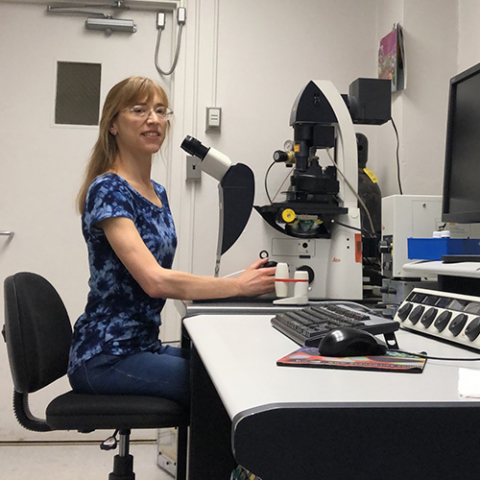
Dr. Christopher Rongo is a Principal Investigator of the Waksman Institute and an Associate Professor of Genetics at Rutgers University.
Research Summary
The Rongo laboratory uses the model organism C. elegans to investigate three research topics at the intersection of neuroscience, genetics, and cell biology. First, we study the membrane trafficking of AMPA-type glutamate receptors (AMPARs), which mediate synaptic communication between neurons and are implicated in multiple diseases of the nervous system. Second, we study how neurons use these different trafficking pathways to respond to sensory experience, the environment, and cellular stress. Finally, we study how different tissues adapt the Ubiquitin Proteasome System (UPS) to degrade proteins and maintain the quality of their cellular proteome at different points in development.
We have used genetic screening approaches to identify and characterize multiple genes that regulate AMPAR trafficking, generating a molecular framework for understanding synaptic structure and function in C. elegans. With this molecular framework in hand, we are extending our studies towards understanding how sensory experience, environment, and age impact the nervous system. The ability to use C. elegans to perform such studies is unparalleled because the cultivation environment for the nematode can be precisely controlled, because its genome is relatively homogeneous, and because its behaviors are simple, quantifiable, and consistent.
Introduction to AMPAR Biology
AMPARs mediate the bulk of excitatory communication between neurons in the brain. These receptors are glutamate-gated ion channels comprised of four subunits that are situated in the postsynaptic plasma membrane. During synaptic communication, the neurotransmitter glutamate is released from the presynaptic terminal and binds to postsynaptic AMPARs, resulting in the entry of ion current and the transduction of electrochemical information into the postsynaptic neuron. The membrane trafficking of AMPARs into and out of the postsynaptic membrane, which regulates the levels of synaptic AMPARs, is a key mechanism by which neurons regulate the efficacy of synaptic communication. An important goal in neuroscience is to understand how neurons within a circuit use AMPAR trafficking as a mechanism to modulate behavior and generate cellular correlates of learning and memory.
AMPARs in C. elegans
AMPAR trafficking has been well studied in dissociated neuronal culture and brain slices, allowing the identification of numerous regulators of AMPAR trafficking in vitro. However, we know much less about how AMPARs are regulated in vivo within circuits of an intact brain, how such regulation is modulated by experience and environment, and how such regulation results in behavioral changes. To address these issues, my laboratory uses a genetic approach to study AMPAR trafficking in C. elegans. These small soil nematodes have a simple and well-characterized nervous system, which can be directly visualized through their transparent cuticle, allowing the observation of GFP-tagged AMPAR subunits in intact, behaving animals. GLR-1 and GLR-2 are C. elegans orthologs for the mammalian AMPAR subunits GluA1 and GluA2, respectively. They act in several defined interneurons to regulate locomotion . Specifically, these receptors are required for animals to reverse direction as part of an overall foraging strategy. Moreover, their glutamate-activated currents can be directly recorded from the interneurons. C. elegans AMPARs are thought to comprise a mixture of GLR-1 homomers and GLR-1/GLR-2 heteromers, and the cofactors SOL-1, STG-1, and STG-2 are also required for AMPAR function. The rate of locomotion reversal behavior reflects the level of AMPAR synaptic signaling in the interneurons and can be used as a measure of AMPAR synaptic abundance. We previously tagged GLR-1 with GFP and observed that GLR-1::GFP receptors, which are fully functional, are localized to synaptic puncta along neurites . We have used this reporter to screen for and study mutants with abnormal AMPAR trafficking. This system affords a rich mixture of genetic, cell biological, electrophysiological, and behavioral tools for studying AMPAR trafficking and function in vivo.
Topic 1: AMPARs Use Multiple Trafficking Pathways To Regulate Synaptic Efficacy
One of the key findings of our research has been that neurons use a diverse and surprising collection of membrane trafficking pathways to regulate AMPAR synaptic abundance and subunit composition, to alter synaptic strength, and to maintain synaptic homeostasis. Our long-term goal is to gain a better understanding of how aberrant membrane trafficking pathways in neurons can lead to neurological disorders and neurodegenerative disease. Some of these pathways are summarized below.
Clathrin-Dependent Endocytosis.
Endocytosis and membrane recycling regulate AMPAR synaptic abundance in both mammalian and C. elegans neurons. GLR-1 endocytosis is regulated by ubiquitination and UNC-11, the C. elegans AP180 clathrin adaptin . This mechanism is used in a homeostatic fashion to regulate GLR-1 synaptic levels in response to neural activity. Through genetic screens, we found that cellular signaling through p38 MAPK promotes GLR-1 endocytosis by activating the small GTPase RAB-5, driving endocytosis rates. Surprisingly, we also found that the E3 ubiquitin ligase RPM-1/FSN-1 inhibits p38 MAPK for this function, demonstrating a novel postsynaptic role for this signaling pathway.
Clathrin-Independent Endocytosis.
Membrane proteins can also be endocytosed by clathrin-independent mechanisms. We demonstrated that GLR-1-containing AMPARs are regulated by a combination of clathrin-dependent and clathrin-independent mechanisms. We found that clathrin-dependent endocytosis of GLR-1 requires ITSN-1, an ortholog of Intersectin. We also found that the PDZ/PTB domain protein LIN-10 mediates the recycling of GLR-1 receptors endocytosed along this pathway. We showed that GLR-1 clathrin-independent endocytosis requires cholesterol, and that the GTPase RAB-10 recycles GLR-1 receptors endocytosed along this pathway.
Retrograde Transport.
Once endocytosed, membrane proteins can be recycled back to the plasma membrane by different routes. We discovered that AMPARs use the retrograde transport pathway, which shuttles cargo back to the Golgi before redistributing it to the plasma membrane. We showed that the small GTPase RAB-6 and the retromer complex regulate GLR-1 recycling, and that LIN-10 is an effector that directly binds to RAB-6 . Little is known about the function of the retrograde pathway and the retromer complex in neurons in vivo, and our findings identified a novel cargo molecule – AMPA receptors – for the pathway. Importantly, the retrograde pathway has been implicated in the processing of Amyloid Precursor Protein (APP) into Ab in Alzheimer’s patients. Our work connects the retromer complex and Rab6 to Mint/X11 proteins, which have been implicated in Ab production, and suggests possible new therapeutic targets for the understanding and treatment of Alzheimer’s.
Topic 2: Modulation of AMPAR trafficking by experience and environment
Another key finding of our research has been that environment and prior sensory experience can modulate behavior in simple circuits by regulating AMPAR trafficking using novel stress response pathways and synaptic scaffolding molecules. Our long-term goal is to understand the impact of oxidative stress during neurological and neurodegenerative disorders, and to characterize the stress response pathways, which are potential therapeutic targets for minimizing neurological damage.
Experience-Dependent Remodeling Of AMPAR Subunit Composition.
We have explored the effect of sensory experience on AMPAR trafficking within the mechanosensory circuit . GLR-1 plays a key role in this circuit, receiving synaptic signals from the sensory neurons and integrating this information into an avoidance behavioral response. We found that prior sensory experience modulates the synaptic localization and subunit composition of AMPARs in this circuit through the scaffolding molecule MAGI-1 and direct receptor ubiquitination . In addition, prior mechanosensory experience results in long-term changes in the sensitivity of the circuit to habituation; these long-term changes – a simple form of behavioral metaplasticity – require MAGI-1 activity. Our findings provide one of the first demonstrations of experience altering AMPAR localization and plasticity in vivo, and help to bridge the gap in our knowledge between synaptic molecules and their roles in the neuronal ensembles that give rise to learned behavior and memory.
Oxygen Levels Regulate AMPAR Trafficking Through A Novel Mechanism.
Environment can also impact nervous system function, and neurons can respond to accommodate a changing environment. Specifically, oxygen influences behavior in many organisms, and low oxygen levels (hypoxia) can have devastating consequences for neuron survival due to excitotoxicity. We showed that hypoxia blocks the membrane recycling of GLR-1-containing AMPARs to synapses and depresses glutamatergic signaling . Surprisingly, the canonical transcription factor that mediates most cellular hypoxia responses is not required for this effect. Instead, a specific isoform of the prolyl hydroxylase EGL-9 binds to and recruits LIN-10 to endosomes, thereby antagonizing the function of CDK-5, a negative regulator of LIN-10. Our discovery demonstrates a novel way by which animals can sense and respond behaviorally to oxygen levels. It identifies a novel substrate of the EGL-9 prolyl hydroxylase. Finally, it indicates that neurons have signaling pathways that play a neuroprotective function to help minimize damage during ischemic events by using molecular and cellular mechanisms more diverse than originally appreciated.
Topic 3: The Functions of the Ubiquitin Proteasome System in Multicellular Animals
The major finding of this research is that the Ubiquitin Proteosome System (UPS) plays major, unexpected roles in regulating AMPAR trafficking and organismal lifespan in response to growth factor signaling. Our findings shed light both on the mechanisms by which neurons remodel synapses in response to nervous system activity, and on the molecular and cellular basis of neurological disorders associated with UPS dysfunction.
Multiple E3 Ubiquitin Ligases Regulate AMPAR Trafficking.
Ubiquitination – the attachment of ubiquitin to substrate proteins targeted for degradation by the proteasome – is implicated in neuronal function and synaptic remodeling. Ubiquitination is catalyzed by E3 ubiquitin ligases, which recognize specific substrates and covalently attach ubiquitin to lysine side chains on those substrates. We identified the E3 ligase RPM-1 as a regulator of GLR-1 endocytosis. We also identified KEL-8 as a Cullin3-Dependent Ubiquitin Ligase (CDL3) that regulates AMPAR turnover , demonstrating a novel postmitotic role for CDL3. Our findings showed that CDL complexes assemble with numerous different substrate receptors, allowing them to recognize a large repertoire of substrates. Finally, we identified the ubiquitin-conjugating variant UEV-1 as a regulator of AMPAR turnover along the clathrin-independent pathway. UEV-1 binds to the ubiquitin-conjugating enzyme UBC-13 to promote the formation on noncanonical K63-linked polyubiquitin chains. The function of K63-linked polyubiquitination is poorly understood, but clearly important for protein homeostasis and in neurodegenerative disease.
Growth Factor Signaling Activates The UPS To Modulate Lifespan.
Our genetic screens led us to explore additional multicellular functions of the Ubiquitin Proteasome System (UPS). We generated a GFP-based reporter system for UPS activity in C. elegans, allowing us to query UPS activity in specific tissues and at specific points along development. Using this reporter, we found that epithelial cells undergo a dramatic increase in UPS activity as animals mature into adulthood. Epidermal Growth Factor (EGF) signaling via the Ras/MAPK signal transduction pathway and the PLZF transcription factors EOR-1 and EOR-2 promote the UPS by upregulating the expression of the Skp1 adaptor protein SKR-5 and downregulating the expression of HSP16 chaperone proteins . The Ubiquitin Fusion Degradation (UFD) complex is also required for the observed increase in Ubiquitin Proteasome System activity. This strategic change in protein quality control mechanisms is required to remove oxidized proteins, maintain protein homeostasis, and promote organismal longevity. The mechanism by which growth factor signaling contributes to cellular and organismal longevity is not clear, and remains an important topic in cell biology and aging. Our findings are critical to these fields, as we showed for the first time how growth factors can regulate longevity by directly regulating the expression of Ubiquitin Proteasome System components and therefore global UPS activity.