Nickels Lab
Research Overview
Our research aims to understand the mechanisms governing transcription, the first step of gene expression. Transcription in all cells is carried out by members of a family of conserved multi subunit RNA polymerases (RNAP). Within this family, Escherichia coli RNAP serves as an exceptional model system for mechanistic studies of transcription and as a paradigm for understanding gene expression in bacteria.
Contact Information
Waksman Institute of Microbiology
190 Frelinghuysen Road
Nickels Lab
Piscataway, NJ 08854
United States
Selected Publications
Complete list of publications: [Google Scholar] [Pubmed]
Promoter-sequence determinants and structural basis of primer-dependent transcription initiation in Escherichia coli.
Skalenko KS, Li L, Zhang Y, Vvedenskaya IO, Winkelman JT, Cope AL, Taylor DM, Shah P, Ebright RH, Kinney JB, Zhang Y, Nickels BE. Proc Natl Acad Sci U S A. (2021) 118, e2106388118.
XACT-seq comprehensively defines the promoter-position and promoter-sequence determinants for initial-transcription pausing.
Winkelman JT, Pukhrambam C, Zhang Y, Shah P, Taylor DM, Ebright RH, and Nickels BE. Molecular Cell (2020) 79, 797-811.
Highly efficient 5' capping of mitochondrial RNA with NAD+ and NADH by yeast and human mitochondrial RNA polymerase.
Bird JG, Basu U, Kuster D, Ramachandran A, Grudzien-Nogalska E, Towheed A, Wallace DC, Kiledjian M, Temiakov D, Patel SS, Ebright RH, and Nickels BE. eLife (2018) 7, pii: e42179.
“CapZyme-Seq” comprehensively defines promoter-sequence determinants for RNA 5' capping with NAD+.
Vvedenskaya IO, Bird JG, Zhang Y, Zhang Y, Jiao X, Barvík I, Krásný L, Kiledjian M, Taylor DM, Ebright RH, and Nickels BE. Molecular Cell (2018) 70, 553-564. “CapZyme-Seq” comprehensively defines promoter-sequence determinants for RNA 5' capping with NAD+. Molecular Cell (2018) 70, 553-564.
The mechanism of RNA 5′ capping with NAD+, NADH, and desphospho-CoA.
Bird JG, Zhang Y, Tian Y, Panova N, Barvík I, Greene L, Liu M, Buckley B, Krásný L, Lee JK, Kaplan CD, Ebright RH, and Nickels BE. The mechanism of RNA 5′ capping with NAD+, NADH, and desphospho-CoA. Nature (2016) 535, 444–447.
Multiplexed protein-DNA crosslinking: scrunching in transcription start site selection.
Winkelman JT, Vvedenskaya IO, Zhang Y, Zhang Y, Bird JG, Taylor DM, Gourse RL, Ebright RH, and Nickels BE. Multiplexed protein-DNA crosslinking: scrunching in transcription start site selection. Science (2016) 351, 1090-1093.
Massively systematic transcript end readout, “MASTER”: transcription start site selection, transcriptional slippage, and transcript yields.
Vvedenskaya IO, Zhang Y, Goldman SR, Valenti A, Visone V, Taylor DM, Ebright RH, and Nickels BE. Massively systematic transcript end readout, “MASTER”: transcription start site selection, transcriptional slippage, and transcript yields. Molecular Cell (2015) 60, 953-965.
Interactions between RNA polymerase and the "core recognition element" counteract pausing.
Vvedenskaya IO, Vahedian-Movahed H, Bird JG, Knoblauch JG, Goldman SR, Zhang Y, Ebright RH, and Nickels BE. Interactions between RNA polymerase and the "core recognition element" counteract pausing. Science (2014) 344, 1285-1289.
Growth phase-dependent control of transcription start site selection and gene expression by nanoRNAs.
Vvedenskaya IO, Sharp JS, Goldman SR, Kanabar PN, Livny J, Dove SL, and Nickels BE. Growth phase-dependent control of transcription start site selection and gene expression by nanoRNAs. Genes and Development (2012) 26, 1498-1507.
NanoRNAs prime transcription initiation in vivo
Goldman SR, Sharp JS, Vvedenskaya IO, Livny J., Dove SL, and Nickels BE. NanoRNAs prime transcription initiation in vivo. Molecular Cell (2011) 42, 817-825.
Direct detection of abortive RNA transcripts in vivo.
Goldman SR, Ebright RH, and Nickels BE. Direct detection of abortive RNA transcripts in vivo. Science (2009) 324, 927-928.
Current Lab Members
Principal Investigator
-

Dr. Bryce Nickels
bnickels@waksman.rutgers.edu

Research Faculty
-
Dr. Irina Vvedenskaya
irinavv@waksman.rutgers.edu
Postdoctoral Researchers
-
Hoa Vu
htv9@waksman.rutgers.edu
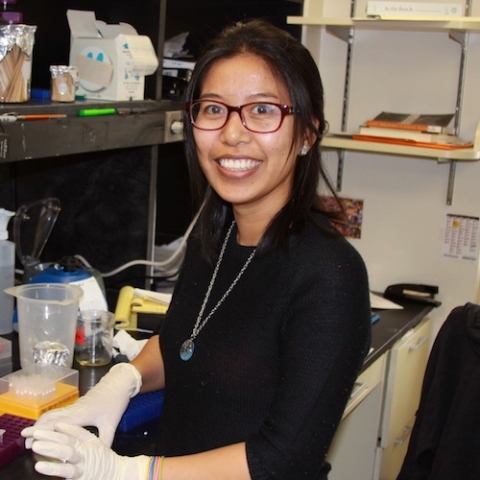
Lab Researchers
-
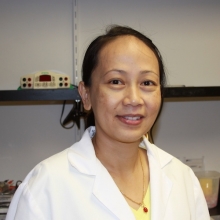
Dr. Chirangini Pukhrambam
chirangini.pukhrambam@rutgers.edu